By David Dunér
The following is the first part of a journal article that was published in Zygon: Journal of Religion and Science 51:2 (June 2016), 450–479.
Introduction: Astrotheology and the Plurality of Worlds
The extraterrestrial life debate, or the plurality of worlds debate, intensified in the seventeenth and eighteenth centuries (Dick 1982; Guthke 1983; Crowe 1986; Dick 1996; Brake 2006; Crowe 2008; Dunér 2012; 2013a; 2013e; see also Michael Crowe’s paper in this section). With the new heliocentric system, earth had become a planet like the others and no longer the center of the universe. With the invention of the telescope, topographical features on the moon were revealed similar to those on earth. Added to these explanations and observations, the discoveries of new worlds overseas led to cultural encounters with foreign ways of life. The possible existence of life unrelated to our own earthly, European culture led also to a heated debate on the unique status of the human being and of Christianity. When rejecting Christianity was not an option, philosophers and theologians had to either deny the existence of other worlds or reconcile the idea with Christian dogmas (Dick 2009, 175 f.). One of those who discussed the new scientific world-view and its implications for theology was the Swedish natural philosopher and theologian Emanuel Swedenborg. In his works, which I will show in the following, there is a transition of ideas from natural philosophy to theology, arriving at an eighteenth-century astrotheology, informed by contemporary natural philosophy, which tried to solve those questions that the extraterrestrial life debate raised.
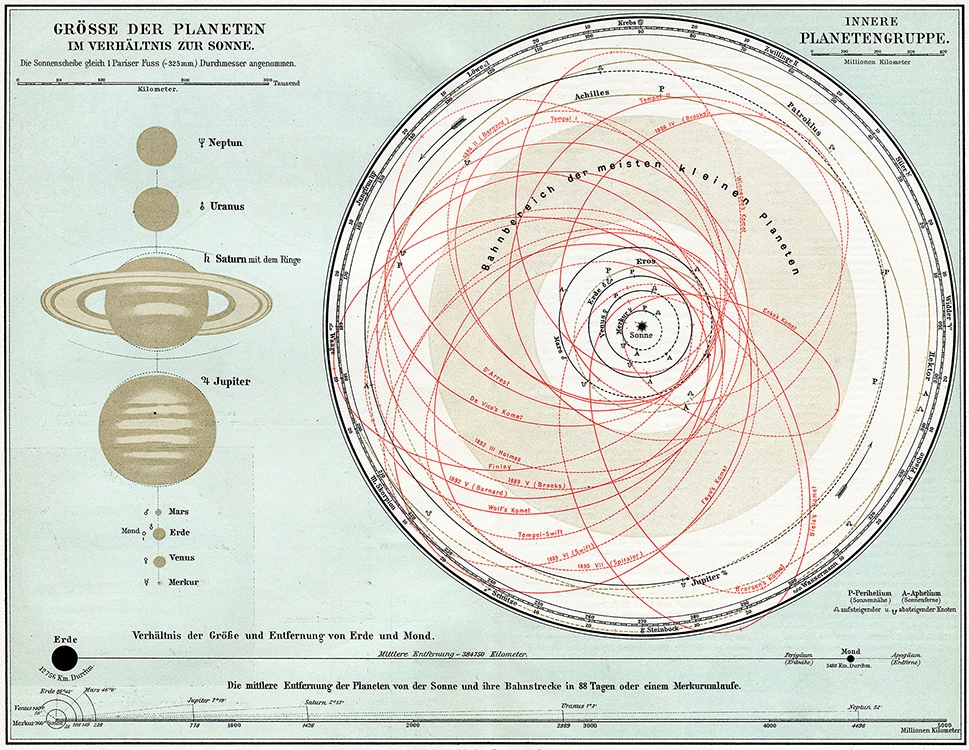
The theological and existential implications of the new astronomical world-view are well-known. When Nicolaus Copernicus showed in 1543, in his De revolutionibus orbium coelestium, that earth no longer must necessarily be considered as the center of the universe, the human being, during this transition from a geocentric to a heliocentric world-view, also lost its central position in the divine creation. The planets became earths. When Galileo Galilei (1610) aimed his telescope at the moon in 1609 and found it a rough globe resembling our own planet’s topography of mountains and plains, then earth lost its unique status as the only habitable planet in our solar system. If we find other worlds with similar topographical features as earth, why could these planets not also harbor life? Earth seemed not to have any unique characteristics that we cannot find elsewhere in the universe. Our planet became a planet amongst others. These astronomical observations, along with geographical discoveries of foreign countries and nations on earth, gave material for a genre of space travel stories that blended scientific knowledge with a fictional grip that stretched the imagination to the extreme. It was very much a utopian, satirical genre. Travels to the moon were a way of telling about other possible ways of living, a critique of the mundane, political world in which we live. Well-known are the stories of travels to other worlds by Francis Godwin, John Wilkins, Athanasius Kircher, Savinien de Cyrano de Bergerac, Samuel Brown, Ludvig Holberg, and François Marie Arouet de Voltaire. But there were also others who claimed that they, literally, had been there themselves. One of those space travelers was Swedenborg.
In the extraterrestrial life debate of the seventeenth and eighteenth centuries, our closest celestial body, the moon, was the prime candidate for life on other worlds. However, a number of natural philosophers and scholars also speculated about life on other planets, both within our solar system and beyond its frontiers—for example, on Venus (Dunér 2013e) and Jupiter. One of the most famous and popular accounts defending the plurality of worlds, also read by Swedenborg, is Bernard Le Bovier de Fontenelle’s book Entretiens sur la pluralité des mondes (1686), which consists of six evening discussions on the plurality of worlds between a philosopher and an aristocratic lady in the gardens of a country chateau. Perhaps, wonders the philosopher, there are astronomers on Jupiter; and perhaps we cause them to engage in scientific quarrels, so that some Jovian philosophers must defend themselves when they put forward the ludicrous opinion that we exist. Their telescopes are directed toward us, as ours are toward them, “that mutual curiosity, with which the inhabitants of these Planets consider each other, and demand the one of the other, What world is that? What people inhabit it?” (Fontenelle 1686; 1702 trans., 93 ). Another prominent natural philosopher, Christiaan Huygens, expresses in Cosmotheoros (1698) his thoughts about extraterrestrial life, and believed that life on other planets is similar to what we find on earth. He notes that liquid water is necessary for life, and he thought he saw darker and lighter spots on the surfaces of Mars and Jupiter, which must be understood as water and ice. Beyond our solar system there are stars of the same sort as our sun—and why, he asks, would not they, in turn, have their own planets and moons? Huygens’s extraterrestrials are in many ways just like earthlings; they have mathematics, astronomy, music, similar intellect, and moral conceptions.
Some natural philosophers even speculated about the intelligence of these extraterrestrials. The philosopher Immanuel Kant—who had, as we will see, a complicated relation to Swedenborg’s spiritual teachings—wrote in Allgemeine Naturgeschichte und Theorie des Himmels (1755) that the intelligence of the extraterrestrials becomes “more excellent and perfect in proportion to the distances of their habitats from the sun.” The Mercurians and Venusians are according to Kant less intelligent than earthlings who are exactly in the middle. The Jovians and Saturnians are superior beings. Kant wrote: “From one side we saw thinking creatures among whom a man from Greenland or a Hottentot would be a Newton, and on the other side some others would admire him as [if he were] an ape” (Kant 1755, 189 f.; Crowe 1986, 52 f.). Interestingly, here Kant actually discusses how the body functions of humans are a result of their location in the solar system, and also how this location and their bodies affect their minds and their ability to think.
There was also a lively extraterrestrial life debate in Swedenborg’s native country. Two dissertations were defended in the 1740s in Uppsala with the astronomy professor Anders Celsius chairing the proceedings, of which one refuted the idea of a habitable moon, while the other defended the idea of the plurality of worlds (Celsius 1740; 1743). Of more relevance for Swedenborg was a short story about traveling to the moon written by the inventor Christopher Polhem with whom Swedenborg collaborated closely for a couple of years. Polhem’s Nyia tiender uthur månan (News from the moon) from the 1710s tells about a Sami who travels to the moon (Dunér 2013b). A Sami had been engaged by some learned men in Uppsala to use wings to fly in the air, but after several unsuccessful flight attempts, another Sami, who was a magician, suggested another way of traveling to the moon. With the help of his magic drum, he could travel there. After spending seven months on the moon, while learning the language of the Lunarians, he returned to earth and told about everything he had seen and heard on the moon.
Natural philosophy and theology were intertwined in the seventeenth- and eighteenth-century plurality of worlds debate. God’s providence upholds the laws of nature, and the wonderful ingenuity and diversity in nature indicated that there is a clever divine watchmaker behind the creation. But the very possibility of life on other planets raised a number of theological problems. Is humankind unique in the universe? Are aliens like us, or of higher or lower intelligence and morality? And how does the idea of habitable worlds fit into God’s plan with his creation? The idea that there could be life on other planets became more accepted by philosophers and theologians. In the Middle Ages, because of philosophical reasons, especially due to the dominance of Aristotelian philosophy, it had been impossible; it became now not just a possibility, but a probability, due to the new cosmology, new observations, and interpretations. If this idea raised serious objections in the early seventeenth century because it seemed to be contrary to Christian truths, it could in the eighteenth century rather support the belief in an omnipotent creator. Common arguments against the existence of other worlds had been that it would lead to a questioning of the uniqueness of the human being and its central position in God’s creation. And what would happen with Christ’s death on the cross? Did our Jesus die also for the sins of the extraterrestrials, or are there a countless number of Jesuses out there in space who died on their crosses? And had all these inhabited worlds their Adams, their apples of Eves, their snakes? Or did Christ the Redeemer hop, as Thomas Paine asked, from one world to another in an endless succession of deaths? (Paine 1794; Dick 2009, 176; see Michael Crowe’s paper in this section).
In the eighteenth century, however, many natural philosophers and theologians came to defend a physico-theological view that the wonderful and astonishing order and efficiency we can see in nature, and the countless life forms we can find on earth, show that there must be an omnipotent and infinitely wise Creator. According to the physico-theologists, there were good arguments that life must exist on other planets. The all-powerful Creator must have filled the entire universe with life, and he could not have left all stars and planets as an immense, empty, barren desert. One of the most famous promoters of such a physico-theological interpretation was the English theologian William Derham who in his book on astrotheology from 1713 (translated into Swedish in 1735) put forward that the stars and planets indicated the existence of an ingenious creator. The stunning mechanics of the starry sky tells us about a divine watchmaker who had created everything according to a certain pre-established plan. Derham believed that the moon was inhabited, and there were many inhabited solar systems and planets besides our own. Our earth is just a point compared to the entire universe. And for this little point, we fight with fire and sword. By citing Seneca, Derham (1715, 235; Seneca, Naturales quaestiones, 1, praef. 8, 11) points out how ridiculous this is, when “above there are vast spaces, to whose possession the Mind is admitted.”
Probably one of the most original and curious contributions to the debate concerning the plurality of worlds in the eighteenth century was a work that, without the slightest irony, provided a sincere account of its author’s encounters with extraterrestrials. In 1758, the Swedish spiritual visionary Emanuel Swedenborg published a book that described his encounters with extraterrestrial spirits, which he entitled De telluribus in mundo nostro solari (Goerwitz 1985; Acton 1996; Bedford 2006). Swedenborg did not only say that extraterrestrial life might exist, and his travels among inhabited worlds are not just the stuff of a utopian novel; he in fact claimed that he had met these extraterrestrial beings and talked to them in person. In this paper I will show that Swedenborg’s belief in extraterrestrial life, how seemingly strange, rests on his work as a natural philosopher and on various scientific beliefs that were circulating during his time. I will, to begin with, sketch his astrotheology that could be found in his natural philosophical works, where he puts forward a number of ideas—such as the astrodynamics of the solar system, the micro-macrocosmic analogy, and the creation of the natural world—and his endeavor to reconcile the words of the Bible with contemporary natural philosophical theories that are important for understanding his later theological treatment of the question of the plurality of worlds in De telluribus. We will follow Swedenborg’s astrotheological transformation chronologically, but first I need to introduce the main figure of this paper and put his works and teachings in a biographical and intellectual context.
Swedenborg—Natural Philosopher and Theologian
Emanuel Swedenborg (1688–1772) was a Swedish natural philosopher and assessor of mines, who later became an original Bible exegete, spirit-seer, and theologian. As a natural philosopher with Cartesian and Wolffian inclinations, he wrote a number of books on mathematics, matter theory, metallurgy, astronomy, anatomy, and physiology (Crasta 1999; Jonsson 1999; Dunér 2013c; 2013d; Schaffer 2014). In the mid 1740s he underwent a religious conversion. He found his natural philosophical aspirations as insufficient, partially failed, and fruitless. He abandoned his scientific work and went on traveling in his dreams to a totally different world, to a spiritual, immaterial world. He claimed that he had discovered the correspondence between the natural and spiritual meanings in the Bible, or as he said, he had received the key to the inner message of the Bible. His novel interpretation of the Bible rests on his correspondence doctrine, i.e., that every physical thing corresponds to an intellectual or moral sense as well as to a theological or divine truth. For example, the creation story is not really about the creation of the earth but about humanity’s own rebirth and maturation, where the six days of creation correspond to six spiritual states.
Swedenborg received the knowledge of these correspondences, as he says, under the guidance of the Lord, through his travels in the spiritual world and his conversations with spirits and angels. With his internal vision, he could see into the afterlife. During sleep, but also during dormant states in the middle of the day, he traveled in his dreams to the world of spirits and angels. The spiritual world is a kind of gathering place for the souls of the dead, from where they then after a time travel on to either heaven or hell. But Swedenborg’s heaven and hell are not places; they are spiritual states. The universe as a whole appears like a gigantic human being, wherein each of us is a miniature of the Universal Human (Maximus Homo). Each part of the human body corresponds with similar parts of the Universal Human, but they also have various spiritual meanings. Swedenborg’s first major theological work was a commentary on Genesis and Exodus, Arcana Coelestia (1749–1756) in eight volumes. This work, which reveals the heavenly secrets hidden in the words of the Bible, summarizes the major elements of his theological thinking. All his theological works—a total of eighteen were published during his lifetime—were written in Latin and printed in Amsterdam and London. In the summer of 1758 he published no fewer than five books, including the work on the earths in our solar system, De telluribus in mundo nostri solari, where he tells us about his conversations with spirits from the other planets in our solar system, but also in other planetary systems in the universe.
Swedenborg’s clairvoyant abilities made him famous in eighteenth-century Europe. Immanuel Kant mentions a story in which Swedenborg saw in his inner mind a fire taking place far away in Stockholm. Kant even wrote a whole book about Swedenborg, Träume eines Geistersehers (1766), where he launches into a bitter tirade against the spirit-seer’s dreams and describes him as a swindler and a liar, and he says that everything Swedenborg wrote had its origin in the pure fantasy of a sick mind. Subsequent research, however, has tried to show that Kant’s view of Swedenborg was more complicated, that Swedenborg in fact had an impact on Kant’s critical turn (Florschütz 1992; Stengel 2008). Swedenborg’s teachings were controversial in Germany. The theologian Johann August Ernesti attacked Swedenborg’s spiritual interpretation of the Bible, while the theologian and philosopher Friedrich Christoph Oetinger, in turn, defended him (Hanegraaff 2007). Oetinger also published Swedenborg’s De telluribus in German in 1770, 1771, and 1776, Von den Erdcörpern der Planeten und des gestirnten Himmels Einwohnern (Stengel 2011, 422 f.). In his Beurtheilungen (1771, 50), Oetinger concluded that Swedenborg’s speculations concerning extraterrestrials, without a doubt, had taken ideas from Huygens’s Cosmotheoros.
Swedenborg’s contrast-rich life, a life that took him from natural philosophy to theology, from rationalism to mysticism, from mathematics to spirit-seeing, has puzzled many scholars (Benz 1948; Toksvig 1948; Sigstedt 1952; Bergmann and Zwink 1988; Brock 1988; Larsen 1988; Lawrence 1995; Wilkinsons 1996; Hallengren 1998; Bergquist 2005; Stengel 2011; Grandin 2013). After being a natural philosopher of the mechanistic school, he turned to what may be perceived as the antithesis of rational, natural science: a deeply religious world-view with the idea of an immaterial spiritual world, where everything tends toward the spiritual and the Divine. Friedrich von Schelling wrote that in Swedenborg’s teachings “the loveliest comfort, the most devout poetry, the most brilliant depth of thought carry on a strange and wonderful war with abstract dogmatism and poor mathematics” (Horn [1954] 1997, 32). Despite Swedenborg’s seemingly contradictory course in life, recent research has shown a clear relationship between the former natural philosopher and the latter theologian (Lamm [1915] 2000; Jonsson 1999; Dunér 2013c).
The Cosmic Cycle
In order to explain how Swedenborg as theologian and spirit-seer could assume the existence of intelligent life on other planets, we need to trace these ideas back to his natural philosophical works. His conception of spirits from other worlds is dependent on his natural philosophical theories developed from the 1710s to the 1730s. In his very first works on astrodynamics in the late 1710s, we find a dependence on classical ideas about the divine circle, and the heliocentric world-view is explained in Cartesian terms. One could especially note his endeavor to reconcile the statements of the Bible with the contemporary heliocentric world-view.
Stars, suns, planets, and moons are recurring themes in Swedenborg’s natural philosophy, poetics, and theology, stretching from a small poem in the year 1700 to his later travels in the universe of the spiritual world. Swedenborg’s astronomical studies of the celestial movements are connected to the seasons, times, and ages, to navigation on the seas, and to the creation of the solar system. It is a universe of spiral motions, whirls, and micro-macrocosmic correspondences (Dunér 2002). Time is a cosmic cycle, through the orbit of the earth around the sun, with the seasons repeated in a circle, or the peregrinations of the heavenly bodies, the annual tasks in the fields, the ebb and flow of the sea, the course of rain and rivers, the stages of life and regeneration. The preacher in Ecclesiastes starts with the vanity of the eternal, meaningless cycle; as generations come and go, the sun rises and sets, the wind goes toward the south and turns to the north. All rivers run into the sea, yet the sea never becomes full. There is nothing new under the sun.
There is a longing for immobility in the classical world-view with its spherical celestial bodies in circular movements. Swedenborg develops it into a world of spiral bubbles in spiral motion and whirling spheres, constantly in movement. Swedenborg followed René Descartes in the tracks of his vortical theory. Aristotelian natural philosophy had been forced to concede, with its circles and its crystalline, concentric spheres representing an immutable, eternal celestial order, in contrast to the notion of rectilinear movement upward or downward that dominated under the moon, on the imperfect, mutable earth, as it was put forward in the physics of Aristotle (Physikēs, 8.8.261b27–262a12; Peri ouranou, 1.2.268b15–26). Swedenborg adopted Cartesian vortices, a whirling movement that applies both above and below the moon, to the biggest and the smallest alike. But he does not let go of the idea of a perfect order established by an infinite geometrician. The world is a reflection of perfect figures. The doctrine of the perfection of the circle lived on as an important basis of his thought, immortalized as a spiral.
The whole of Swedenborg’s mechanistic natural philosophy actually seeks to provide purely mechanical explanations such as pressure and motion in a continuum. Occult forces working at a distance, thus also Isaac Newton’s theory of gravity, had no explanatory value. What heaven has to say is merely that God is an omnipotent and omniscient Creator. Swedenborg had distanced himself from the kind of interpretations embraced by his father, the Bishop Jesper Swedberg, who read more concrete messages into the sudden celestial phenomena. Swedberg wrote to the priest he had sent to the Christina congregation in Pennsylvania, Andreas Hesselius, to tell of “the dreadful and terrible celestial sign” that had been seen on the night of March 6, 1716. Hesselius replied that this “would be like the gleaming of swords with their points facing down, and many quickly moving and unusual flashes. May God let it not mean something evil!” (Swedberg 1941, 345; [1732] 1985, 85 f.; Schück 1918, 111). Swedenborg did not believe in augury; stars and comets are not portents of coming misfortunes, but as we will see next, astronomy has an explanatory value for interpreting some problematic statements of the Old Testament.
The Age of the Antediluvians
Everything is perishable; nothing lasts forever. “Since this is the case with earthly things, one can well conclude as to things superterrestrial, and that even there everything progresses toward a goal and a [state of] rest,” wrote Swedenborg in 1717 in En ny theorie om jordens afstannande (A new theory about the retardation of the earth) (Swedenborg, Opera III, 271; Linköping Diocesan Library, N 14a, no. 34; Photolith. I, 28–65; trans., 43). In this manuscript he puts forward a number of reasons for his opinion that the earth has been moving increasingly slowly since the beginning. Ether causes a resistance in the earth’s orbit, and air in the motion around the axis, which makes the years and the days longer and longer. He bases this on an analogical thinking: there are similarities between the mechanics of the universe and the tools of humankind. The earth rolls and spins on its axis, or its central pole, as when one takes a ball and throws it into the water, when a point on a wheel rotates around its axis or the spindle on a spinning wheel. Another reason why the movement around the axis must have been faster in the past can be detected in the roundness of the earth. The irregularities have been rubbed off and subsided in spherical form. “If one takes a lump of clay and rolls it around its axis in water, it is formed into an oval” (Opera III, 272 f.; trans., 45). For Swedenborg, then, in contrast to a Newtonian explanation, the earth is oval owing to the resistance of the medium.
There is also written evidence, according to Swedenborg, for the theory that the world is slowing down, as when the Bible and classical poets talk of an eternal spring in primeval times. When the year and the days were shorter, the antediluvians, those who lived before the Deluge, could reach an age of 700 to 800 years. So Methusalah’s 969 years actually correspond to only 121⅛ of our years. Perhaps with the support of Johan Peringskiöld’s genealogical tables in King Charles XII’s Swedish Bible, Swedenborg calculated that in the time from Adam to the Deluge, the age of the antediluvians had decreased by 100 years in 1,656 years. If the earth had not been flooded, it would now have had an age of 18,212 years.
Around 1718 to 1719 he wrote two other versions about the motion and position of the earth. In the first version, in manuscript, En ny mening om jordens och planeternas gång och stånd eller några bewis at jorden löper alt sachtare och sachtare: at winter och sommar, dagar och dygn til tiden blifwa lengre och lengre in til werldsens sista tid (1718), he puts forward “a new opinion about the motion and position of the earth and the planets or some proof that the earth is moving more and more slowly: that winter and summer, days and nights are becoming longer and longer until the end of the world.” The increasing distance of the earth from the sun has made it poorer and less fertile. But this has not been noticed, and no wonder, for “we have not been aware that our earth rotates like a ball each day: indeed our vision often deceives us in small matters; one does not notice that the ship is moving forward or backward.” If one sails around the earth one does not know that one has traveled in a circle if one does not return to the same place again or finds that one has lost a day. “Behold, thus are we deceived by the light of our own senses, and are blind with them, and believe an untruth to be true” (Swedenborg, Opera III, 285, cf. 303). We therefore cannot trust our senses. It requires reason and geometry for Swedenborg to make us truly able to see.
Swedenborg published his theory in 1719 in Om jordenes och planeternas gång och stånd (On motion and position of the earth and the planets). A theory about the origin of the earth from chaos ought to follow geometry and be compared with the opinions of Descartes and Newton. But that would be beyond the scope of the present work, he says. Instead he puts forward a number of reasons for the decreasing speed of the earth based on arguments in a Rudbeckian tradition in which, according to the Swedish physician and historian Olof Rudbeck the Elder, ancient myths have something to say, notably that the lost Atlantis actually refers to Sweden in old times. Rudbeck can explain, he writes, why Canaan and the golden land can be compared “with our mountains and iron-cliffs, its bright and delightful summer with our chilly and cloudy winter” (Swedenborg, Opera III, 301). God’s word; Ovid; other pagan poets such as Homer, the “True Grandfather of Poets”; and Plato’s Atlantis tell us that the earth once had “a glorious air, a constant spring, a golden age, an Eden and Paradise, an earth inhabited by Atlas” (Swedenborg, Opera III, 306, cf. 287; Homer, The Odyssey I, 7.112–132). There was a heaven here on earth. Life flourished in the eternal spring.
Methusalah’s abnormal age is due to the fact that the earth used to move faster. He lived as long as we do now, but he experienced more summers and winters. With the decreasing speed of the earth’s orbital rotation, the generations after us will regard twenty or thirty years as a high age. Swedenborg is thinking in a variant of the old idea of mundus senescens, the aging earth. Our globe would age and die like a human being (Dunér 2015). In the past there was a golden age, according to the myth related by Ovid (Metamorphoseon, 1.89–150) and Hesiod (Erga kai emerai; trans., 117–120), but now we have descended into a poor age of copper, iron, and clay. Invoking the support of Rudbeck’s Atlantica (1679–1702), as well as Samuel Pufendorf, he seeks to show that Sweden was once a marvelously abundant land, like a Canaan, Savoy, or Italy, like a Florence or Mantua (Swedenborg, Opera III, 312, cf. 293). Swedenborg’s theory is also able to explain why the great island of America is inhabited. During the eternal spring, when the air was still and mild, as in the month of April in today’s Sweden, the first inhabitants walked across Lapland and Greenland to America. Then winter spread itself over the world. Physical experiments could demonstrate that the thesis was correct, as when one rotates a thermometer slowly over a fire, the alcohol rises, but with greater speed to a smaller peak (cf. Swedenborg, De cultu, n. 17, note i; Principia, 447; trans., II, 359 f.). Another experiment can be performed with the vibrations of the pendulum. Just as an ordinary cart wheel makes as many revolutions during a mile regardless of whether one is traveling fast or slow, there are always 365 days in a terrestrial year, irrespective of the speed of the earth’s orbital rotation. In the printed version there were no illustrations to explain the experiments, but in a copy once owned by Swedenborg’s cousin Johan Moræus and then by his son-in-law Carl Linnaeus, Swedenborg’s own drawings are appended (Linnaeus’s copy of Swedenborg’s Om jordenes och planeternas gång och stånd, pp. 24/25, in Linnean Society, London). During his childhood, Linnaeus had been amazed that the early ancestors lived to such an age, but Swedenborg’s theory explained everything to him (Linnaeus, Diæta naturalis, 17).
What the Bible says about the signs that will precede the last days is compatible with the retardation of the earth, with reference to the description of the destruction of Jerusalem in Luke 21:25: “And there shall be signs in the sun, and in the moon, and in the stars; and upon the earth distress of nations, with perplexity; the sea and the waves roaring.” The earth will be destroyed, Swedenborg warns; the human race will dry up, barrenness and famine will spread. There will be signs visible in sun and moon, in air and sea, “dreadful eclipses shall come, causing the peoples anxiety and fright,” stars shall fall down, “the sea and the wave shall roar” with storms and rain (Opera III, 319, cf. 296). This could be interpreted as showing that Swedenborg at this time read the Bible literally, not embracing a doctrine of correspondences with levels of meaning, and that he believed the Creation, the age of the antediluvians, Noah’s flood, and doomsday to be real events. He transfers the particular history in the Bible to a universal history. To understand the hidden mechanism of the solar system he uses physical and biblical examples.
Of special significance for Swedenborg’s cosmogony and geogony was Thomas Burnet’s theory of the mundane egg in Telluris theoria sacra (1681), which was in his library (Opera III, 297, 319 f.; Jonsson 1999, 27). In a notebook started in the 1710s he made annotations about Burnet’s cosmogonic world egg alongside data from David Gregory’s astronomy about the distance of the planets from the sun, and something about Johannes Kepler’s theory and the hypotheses of Epicurus, Descartes, and Leibniz (Swedenborg, Anatomica et physiologica, 165–186; Burnet 1694, II, ch. X, 137–140; 1697, II, ch. VIII, 184 f.; Gregory 1726). The surface of the earth, according to Burnet, was perfectly smooth, regular, and uniform before the deluge, without mountains or oceans. The earth arose from chaos, a fluid mass in which everything was mingled in confusion. Heavier matter sank toward the middle, while lighter matter swam up. The oilier and lighter substances were separated from the heavier ones, floating on the surface, like cream and milk, oil and water (Burnet 1694, I, ch. V, 21; 1697, I, ch. V, 38). Chaos and the idea of the cosmos are based on the conceptual pair of cognitive dialectics, that cosmos presupposes chaos, that order presupposes disorder. The order that we have must come from disorder.
Swedenborg’s theory of the slowing earth is linked not only to Burnet, but also to Polhem and Newton’s Principia. What is most obvious, however, is that he proceeds from the Cartesian vortices. Since all particles in Descartes’s vortex theory seek to move in straight lines, this means that the stronger or heavier particles will describe the largest circles. There is thus a centrifugal force, as mathematically studied by Huygens. According to Descartes, an orbit arises through a balance between the planet’s centrifugal tendency and an opposite pressure from matter in the vortex. Centrifugal and centripetal forces can thus explain planetary orbits. In other words, the spiral path of the earth is due to its centrifugal force being greater than the opposite force of the ether. The idea of the retarding motion of the earth, with a spiral path proceeding from the sun, was something that Swedenborg had read and transcribed several times from Polhem. One of Polhem’s favorite examples, which he varied countless times in order to illustrate the centripetal and centrifugal forces of the planets in the solar vortex, is an experiment with a sphere that is rotated under water (Dædalus Hyperboreus I, 7; Polhems brev, 8–11, 13, 24, 90, 118 f.). Polhem may have derived the inspiration for this experiment from his teacher Rudbeck the Elder, who had just devised a model to describe the movement of the heavenly bodies by revolving a globe in water (Spole 1686).
In November 1719 Swedenborg heard rumors in the capital that the earth had come 25,000 Swedish miles (about 166,000 English miles) closer to the sun (Swedenborg, Opera I, 290 f.; Letters I, 214 f.). He was amazed that such a jump could take place in just a year or two, and he seriously doubted the statement. He told his brother-in-law, the university librarian Eric Benzelius the Younger, that he thought it was unreasonable. Moreover, the claim was in opposition to his own theories. This gave him occasion to comment on the motion and position of the earth. The stronger the movement and rotation in the solar vortex, the further the planets are thrown out from the center, but a weaker movement causes them to be drawn inward. “And it is well known in what proportion the vis centrifuga, in traveling outward and inward, increases according to the speed. Of this, Isaac Newton treats in his Principia.” Swedenborg read Newton with Cartesian eyes, reading vortices into the theory of gravitation. He had probably read a section in Newton’s Principia (1687, II, sect. IV, prop. XV, theorem XII) about the circular motion of bodies in resistant media, where Newton demonstrated that if the force of gravitation varies in inverse proportion to the cube of the distance, instead of to the square, then the planets would not follow an elliptical orbit, but would be hurled away out from the sun in a logarithmic spiral course.
There is no risk yet that the earth will be swallowed up by the sun, Swedenborg assures us: “If the sun grows larger and larger before our eyes, then first would be the time to entertain fear because of it, and to commend oneself to God’s hands” (Swedenborg, Opera I, 293; Letters I, 220). Benzelius also wondered about another thing he had read—namely, a statement that the abode of the damned is in the sun (Benzelius had been reading Neue Zeitungen von gelehrten Sachen, 2 August 1719; Letters I, 218 f.). “I think just the opposite,” Swedenborg replied. The sun is, if anything, the abode of the blessed. For it is at the center of our planetary system, in which all vortical movements have their origin. It has the most splendid light and magnificence, whereas darkness and terrors are furthest away from it. The sun consists of the most subtle particles,
almost devoid of composition, and so put off the denomination of matter, and also of form, weight, and many other properties possessed by compound particles. And it would also seem likely that in this finest, must be the finest essences. A God, an angel, a thing which, moreover, has nothing materiale in its being.
Swedenborg is led toward the idea of God and the sun being brought together in his assurance: “God has his seat in the sun” (Swedenborg, Opera I, 294; Letters I, 220 f.).
Swedenborg could thus explain gravitation in mechanical terms, as did Polhem and other philosophers trained in Cartesian natural philosophy, as being dependent on the pressure of the atmosphere or the “ether.” In Miscellanea observata (1722) Swedenborg expresses this equilibrium in terms of heavier bodies falling downward and lighter ones rising. This Cartesian understanding of gravity becomes odd when he concludes his reasoning by referring to an authority—Newton, the “star of the learned world” (Swedenborg, Miscellanea, 160; trans., 100). Swedenborg did not read Newton’s Newton, but rather Newton with a Cartesian pre-understanding. One contemporary reviewer points out that Swedenborg must be a very special admirer of Newton, since it cannot be unknown to him how little value Newton attached to concocted physical theories based solely on the discoverer’s own fantasies (Historie der Gelehrsamkeit unserer Zeiten 1722, 315–327; trans., The New Philosophy 2003, 565). It is not permissible for a natural philosopher merely to create things from his own brain.
David Dunér is Professor of History of Science and Ideas at Lund University, Sweden. He is Principal Investigator of the research group Space Humanities at Lund University and leader of the scientific working group Historical, Philosophical, Societal and Ethical Issues in Astrobiology of the European Astrobiology Institute. He is author of the book The Natural Philosophy of Emanuel Swedenborg: A Study in the Conceptual Metaphors of the Mechanistic World-View (2013) and editor of the collection of papers The History and Philosophy of Astrobiology: Perspectives on Extraterrestrial Life and the Human Mind (2013).
Visit our Swedenborg Studies bookstore page to explore our scholarly titles >
Read more posts from the Scholars on Swedenborg series >
References
Acton, Alfred. 1996. “Life on the Moon.” New Church Life 116:256–263.
Aristotle. 1986. Peri ouranou. In On the Heavens, ed. William K. C. Guthrie. Cambridge, MA & London: Harvard University Press/Heinemann.
———. 1986. Physikēs. In On the Soul. Parva naturalia. On Breath, ed. W. S. Hett. Cambridge, MA & London: Harvard University Press/Heinemann.
Bedford, Allen J. 2006. “Planets and Perspectives: New Church Theology and the Plurality of Worlds Debate.” The New Philosophy 109:315–340.
Benz, Ernst. 1948. Emanuel Swedenborg: Naturforscher und Seher. München: Rinn.
Bergmann, Horst, and Eberhard Zwink, eds. 1988. Emanuel Swedenborg 1688–1772: Naturforscher und Kundiger der Überwelt. Stuttgart: Württembergische Landesbibliothek.
Bergquist, Lars. 2005. Swedenborg’s Secret: The Meaning and Significance of the World of God, the Life of the Angels, and Service to God. A Biography. London: Swedenborg Society.
Brake, Mark. 2006. “On the Plurality of Inhabited Worlds: A Brief History of Extraterrestrialism.” International Journal of Astrobiology 5(2):99–107.
Brock, Erland J., ed. 1988. Swedenborg and His Influence. Bryn Athyn, PA: Academy of the New Church.
Burnet, Thomas. 1694. Telluris theoria sacra: orbis nostri originem & mutationes generales, quas aut jam subiit, aut olim subiturus est, complectens, libri duo priores de diluvio & paradiso, new ed. Amsterdam.
———. 1697. The Theory of the Earth: Containing an Account of the Original of the Earth, and of All the General Changes which it Hath Already Undergone, or Is to Undergo till the Consummation of All Things, 3rd ed. London.
Celsius, Anders, pres. 1740. Dissertatio astronomico-physica de luna non habitabili, resp. Eric Engman. Uppsala.
———. 1743. Dissertatio philosophica, de pluralitate mundorum, resp. Isacus Svanstedt. Uppsala.
Copernicus, Nicolaus. 1543. De revolvtionibvs orbium cœlestium, libri VI. … Nürnberg; trans., On the Revolutions of Heavenly Spheres. Philadelphia, PA: Running Press, 2002.
Crasta, Francesca Maria. 1999. La filosofia della natura di Emanuel Swedenborg. Milano.
Crowe, Michael J. 1986. The Extraterrestrial Life Debate 1750–1900: The Idea of a Plurality of Worlds from Kant to Lowell. Cambridge: Cambridge University Press.
———. 2008. The Extraterrestrial Life Debate, Antiquity to 1915:A Source Book. Notre Dame, IN: University of Notre Dame.
Derham, William. 1715. Astro-theology or a Demonstration of the Being and Attributes of God, from a Survey of the Heavens, 2nd ed. London; trans. Anders Nicander, Astro-theologie eller Himmelska kropparnes betracktelse. Til ögonskenligit bewis at en Gud är til, och at han det aldrabästa, aldrawisaste och alsmäktigste wäsende är med kopparstycke författad. Stockholm, 1735.
Dick, Steven J. 1982. Plurality of Worlds: The Origins of the Extraterrestrial Life Debate from Democritus to Kant. Cambridge: Cambridge University Press.
———. 1996. The Biological Universe: The Twentieth-Century Extraterrestrial Life Debate and the Limits of Science. Cambridge: Cambridge University Press.
———. 2009. “A Historical Perspective on the Extent and Search for Life.” In Exploring the Origin, Extent, and Future of Life: Philosophical, Ethical, and Theological Perspectives, ed. Constance M. Bertka, 167–185. Cambridge: Cambridge University Press.
Dunér, David. 2002. “Swedenborg’s Spiral.” Studia Swedenborgiana 12(4):1–58.
———. 2012. “The History and Philosophy of Astrobiology.” Special issue of Astrobiology 12(10):901–1016.
———. 2013a. “Introduction: Extraterrestrial Life and the Human Mind.” In The History and Philosophy of Astrobiology: Perspectives on Extraterrestrial Life and the Human Mind, eds. David Dunér, Joel Parthemore, Erik Persson, and Gustav Holmberg, 1–25. Newcastle-upon-Tyne: Cambridge Scholars Publishing.
———. 2013b. “The Language of Cosmos: The Cosmopolitan Endeavour of Universal Languages.” In Sweden in the Eighteenth-Century World: Provincial Cosmopolitans, ed. Göran Rydén, 39–65. Farnham: Ashgate.
———. 2013c. The Natural Philosophy of Emanuel Swedenborg: A Study in the Conceptual Metaphors of the Mechanistic World-View. Dordrecht: Springer.
———. 2013d. “Spheres and Bubbles: Emanuel Swedenborg’s Theory of Matter and the Metaphors of the Mind.” In Emanuel Swedenborg – Exploring a “World Memory”: Context, Content, Contribution, ed. Karl Grandin, 12–33. Stockholm: The Center for History of Science.
———. 2013e. “Venusians: The Planet Venus in the 18th-Century Extraterrestrial Life Debate.” In Meeting Venus: A Collection of Papers Presented at the Venus Transit Conference in Tromsø 2012, eds. Christiaan Sterken, and Per Pippin Aspaas. The Journal of Astronomical Data 19(1):145–167.
———. 2015. “Length of Time Such Civilizations Release Detectable Signals into Space, L, pre-1961.” In The Drake Equation: Estimating the Prevalence of Extraterrestrial Life through the Ages, eds. Douglas A. Vakoch, and Matthew F. Dowd, 241–269. Cambridge: Cambridge University Press.
Florschütz, Gottlieb. 1992. Swedenborgs verborgene Wirkung auf Kant: Swedenborg und die okkulten Phänomene aus der Sicht von Kant und Schopenhauer. Würzburg: Königshausen und Neumann.
Fontenelle, Bernard Le Bovier de. 1686. Entretiens sur la pluralité des mondes. Amsterdam; ed. A. Calame, Paris, 1966; trans. John Glanvill, A Plurality of Worlds. London, 1702.
Galilei, Galileo. 1610. Siderevs nvncivs magna, longeqve admirabilia spectacula pandens, … Venice; trans. William R. Shea, Galileo’s Sidereus Nuncius, or, A Sidereal Message. Sagamore Beach, MA: Science History Publications, 2009.
Goerwitz, III, Richard L. 1985. “Extraterrestrial Life: A study of the Intellectual Context of Emanuel Swedenborg’s Earths in the Universe.” The New Philosophy 88:417–446, 477–485.
Grandin, Karl, ed. 2013. Emanuel Swedenborg – Exploring a “world memory”. Context, content, contribution. Stockholm: The Center for History of Science.
Gregory, David. 1726. Astronomiæ physicæ & geometricæ elementa I, 2nd ed. Genève.
Guthke, Karl S. 1983. Der Mythos der Neuzeit: Das Thema der Mehrheit der Welten in der Literatur- und Geistesgeschichte von der kopernikanischen Wende bis zur Science Fiction. Bern: Francke.
Hallengren, Anders. 1998. Gallery of Mirrors: Reflections of Swedenborgian Thought. West Chester, PA: Swedenborg Foundation.
Hanegraaff, Wouter J. 2007. Swedenborg, Oetinger, Kant: Three Perspectives on the Secrets of Heaven. West Chester, PA: Swedenborg Foundation.
Hesiod. 2006. Theogonia; Erga kai hēmerai. In Theogony, Works and Days, Testimonia, ed. Glenn W. Most. Cambridge, MA & London: Harvard University Press/Heinemann.
Historie der Gelehrsamkeit unserer Zeiten. Leipzig, 1722; trans., The New Philosophy 2003.
Homer. 1995. The Odyssey I, ed. Augustus T. Murray. Cambridge, MA & London: Harvard University Press/Heinemann.
Horn, Friedemann. 1954. Schelling und Swedenborg: Ein Beitrag zur Problemgeschichte des deutschen Idealismus und zur Geschichte Swedenborgs in Deutschland. Lörrach-Stetten; trans. George F. Dole, Schelling and Swedenborg: Mysticism and German Idealism. West Chester, PA: Swedenborg Foundation, 1997.
Huygens, Christian. 1698. Kosmotheōros, sive de terris cœlestibus, earumque ornatu, conjecturæ. The Hague.
Jonsson, Inge. 1999. Visionary Scientist: The Effects of Science and Philosophy on Swedenborg’s Cosmology. West Chester, PA: Swedenborg Foundation.
Kant, Immanuel. 1755. Allgemeine Naturgeschichte und Theorie des Himmels. Königsberg & Leipzig.
———. 1766. Träume eines Geistersehers, erläutert durch Träume der Metaphysik. Riga & Mietau; trans. Gregory R. Johnson, and Glenn A. Magee, Kant on Swedenborg: Dreams of a Spirit-seer and Other Writings, ed. Gregory R. Johnson. West Chester, PA: Swedenborg Foundation, 2002.
Lamm, Martin. 1915. Swedenborg: En studie öfver hans utveckling till mystiker och andeskådare. Stockholm: Geber; trans. Tomas Spiers, and Anders Hallengren, Emanuel Swedenborg: The Development of his Thought. West Chester, PA: Swedenborg Foundation, 2000.
Larsen, Robin, ed. 1988. Emanuel Swedenborg: A Continuing Vision. A Pictorial Biography & Anthology of Essays & Poetry. New York: Swedenborg Foundation.
Lawrence, James F., ed. 1995. Testimony to the Invisible: Essays on Swedenborg. West Chester, PA: Swedenborg Foundation.
Linnaeus, Carl. 1958. Diæta naturalis 1733, ed. Arvid Hj. Uggla. Uppsala: Almqvist & Wiksell.Neue Zeitungen von gelehrten Sachen. Leipzig, 2 August 1719.
Newton, Isaac. 1687. Philosophiæ naturalis principia mathematica. London.
Oetinger, Friedrich Christoph. 1771. Beurtheilungen der wichtigen Lehre von dem Zustand nach dem Tod und der damit verbundenen Lehren des berühmten Emanuel Swedenborgs theils aus Urkunden von Stockholm theils aus sehr wichtigen Anmerkungen verschiedener Gelehrten.
Ovid. 1984. Metamorphoseon. In Metamorphoses I–II, ed. Frank J. Miller. Cambridge, MA & London: Cambridge University Press/Heinemann; trans. John Dryden et al., Metamorphoses, ed. Samuel Garth. Ware: Wordsworth, 1998.
Paine, Thomas. 1794. Age of Reason: Being an Investigation of True and Fabulous Theology. Paris.
Polhem, Christopher. 1941–1946. Christopher Polhems brev, ed. Axel Liljencrantz. Uppsala: Lärdomshistoriska samfundet.
———. 1954. “Nyia tiender uthur månan.” In Christopher Polhems efterlämnade skrifter IV: Varia, ed. Bengt Löw, 338–42. Uppsala: Lärdomshistoriska samfundet.
Rudbeck the Elder, Olof. 1679–1702. Atland eller Manheim … I–IV. Uppsala; ed. Axel Nelson, Atlantica I–IV. Uppsala: Lärdomshistoriska samfundet, 1937–1950.
Schaffer, Simon. 2014. “Swedenborg’s Lunars.” Annals of Science 71(1):2–26.
Schück, Henrik, ed. 1918. Bokwetts Gillets protokoll (1719–31). Uppsala: Almqvist & Wiksell.
Sigstedt, Cyril Odhner. 1952. The Swedenborg Epic: The Life and Works of Emanuel Swedenborg. New York: Bookman Associates.
Spole, Anders, pres. 1686. Hydro-pneumatica de elaterio & phoenomenis globulorum aereorum sub aqua…, resp. Bonde Humerus. Stockholm.
Stengel, Friedemann, ed. 2008. Kant and Swedenborg: Zugänge zu einem umstrittenen Verhältnis. Tübingen: Max Niemeyer Verlag.
———. 2011. Aufklärung bis zum Himmel: Emanuel Swedenborg im Kontext der Theologie und Philosophie des 18. Jahrhunderts. Tübingen: Mohr Siebeck.
Swedberg, Jesper. 1732. America illuminata, skrifwen och vtgifwen af thes biskop, doct. Jesper Swedberg, åhr 1732. Skara; new ed., Stockholm: Proprius, 1985.
———. 1941. Jesper Swedbergs Lefwernes beskrifning, ed. Gunnar Wetterberg. Lund: Vetenskapssocieteten i Lund.
Swedenborg, Emanuel. Collectanea physica-mathematica, såsom ock åtskilligt rörande Sveriges natural historia, hvaraf gjordes bruk vid Societatis literariae inrättande i Upsala. Linköping Diocesan Library, N 14a.
———. Anatomica et physiologica. Royal Academy of Sciences, Stockholm, cod. 53 (114).
———. 1716–1718. Dædalus Hyperboreus: eller några nya mathematiska och physicaliska försök och anmerkningar: som wälborne herr assessor Polhammar och andre sinrike i Swerige hafwa giordt och nu tijd efter annan til almen nytta lemna I–VI. Uppsala & Skara; facsimile, In Kungliga vetenskaps societetens i Upsala tvåhundraårsminne, ed. Nils C. Dunér. Uppsala: Kungl. Vetenskaps-Societeten i Uppsala, 1910.
———. 1717. En ny theorie om jordens afstannande; ed., In Opera III; trans. Hugo Lj. Odhner, “A New Theory about the Retardation of the Earth.” The New Philosophy, April 1950.
———. 1718. En ny mening om jordens och planeternas gång och stånd eller några bewis at jorden löper alt sachtare och sachtare: at winter och summer, dagar och dygn til tiden blifwa lengre och lengre in til werldsens sista tid; ed., In Opera III.
———. 1719. Om jordenes och planeternas gång och stånd: thet är några bewisliga skiäl at jorden aftager i sitt lopp och nu går longsammare än tillförene; giörande winter och sommar, dagar och nätter lengre i anseende til tiden nu än förr. Skara.
———. 1722. Miscellanea observata circa res naturales & præsertim circa mineralia, ignem & montium strata I–III. Leipzig; trans. Charles Edward Strutt, Miscellaneous Observations Connected with the Physical Sciences, new ed. Bryn Athyn, PA: Swedenborg Scientific Association, 1976.
———. 1734. Principia rerum naturalium sive novorum tentaminum phænomena mundi elementaris philosophice explicandi. Dresden & Leipzig; trans. Augustus Clissold, The Principia; or, the First Principles of Natural Things, Being New Attempts toward a Philosophical Explanation of the Elementary World I–II, 3rd pr. Bryn Athyn, PA: Swedenborg Scientific Association, 1988.
———. 1745. De cultu et amore Dei. London; trans. Alfred H. Stroh, and Frank Sewall, The Worship and Love of God. West Chester, PA: Swedenborg Foundation, 1914.
———. 1758. De telluribus in mundo nostri solari, quæ vocantur planetæ. London; German trans. Friedrich Christoph Oetinger, Von den Erdcörpern der Planeten und des gestirnten Himmels Einwohnern, allwo von derselben Art zu denken, zu reden und zu handeln, von ihrer Regierungs-Form, Policey, Gottesdienst, Ehestand und überhaupt von ihrer Wohnung und Sitten, aus Erzählungen deselben Geister selbst durch Emanuel Schwedenborg Nachricht gegeben wird … Anspach, 1771; English trans. John Chadwick, The Worlds in Space. London: Swedenborg Society, 1997.
———. 1869–1870. Em. Svedenborgii autographa ed:photolith I–VIII, ed. Rudolf Leonhard Tafel. Stockholm.
———. 1907–1911. Opera quædam aut inedita aut obsoleta de rebus naturalibus I–III, ed. Alfred H. Stroh. Stockholm.
———. 1948–1955. The Letters and Memorials of Emanuel Swedenborg I–II, ed. Alfred Acton. Bryn Athyn, PA: Swedenborg Scientific Association.
Toksvig, Signe. 1948. Emanuel Swedenborg: Scientist and Mystic. New Haven, CT: Yale University Press.
Wilkinsons, Lynn R. 1996. The Dream of an Absolute Language: Emanuel Swedenborg and French Literary Culture. Albany, NY: State University of New York Press.