The Swedenborg Foundation is changing how our books reach you. Starting October 1, 2026, we’re leaving our longtime distributor, the Chicago Distribution Center, to become a fully self-distributed publisher—selling directly through our own online Shopify store and Amazon Seller Account, as well as digital and wholesale options. Here’s how that decision fits into 176 years of publishing history, and why now.
Overseeing the printing and publishing of books is the longest-running strategy the Swedenborg Foundation has used to accomplish its mission. Michael Castleman, in his book The Untold Story of Books: A Writer’s History of Book Publishing, outlines three distinct eras of “book business.” The Swedenborg Foundation has been serving its mission through them all.
Castleman dates the first era back to Johannes Gutenberg’s invention of movable type in Europe in 1440 which, he writes, began a 450 year “author-centric cottage industry” of publishing—think of Swedenborg paying out-of-pocket for his books to be printed and published in England, and later, the first members of the Swedenborg Foundation pooling resources to print English translations. Then Castleman describes how publishing became industrialized at the turn of the 20th century, beginning the second book business phase. This new model was publisher-centric and reflects what is commonly known today as “traditional publishing.” Imagine the excitement of an author whose agent has sold the rights of their book to Penguin Random House.
Now we are in a third era, which, as you might guess, has the digital revolution to thank. Since the beginning of the third millennium, the publishing industry has not had it easy. The systems built in the industrialized era have faced disruption after disruption, from Amazon’s takeover to the growing dominance of audiobooks in the market, as Castleman notes. The Swedenborg Foundation, meanwhile, has managed to maintain its course.
Chartered in 1850, we have navigated the sea changes in the book publishing world, shifting tacks while staying oriented to our goals. We began by printing and distributing Swedenborg’s theological writings (starting with Divine Love and Wisdom in 1851). In 1928 we expanded into the role of a publisher, publishing works by authors that engage with Swedenborg’s ideas. And now in Castleman’s third book business era, we are making strategic choices for how best to serve our mission amidst the modern publishing world.
In 1749, Swedenborg received a letter from his publisher, John Lewis, informing him that in the two months since the release of the first volume of Arcana Coelestia only four copies had sold. A disappointing figure. Nevertheless, Swedenborg carried on with determination, changing tacks as needed to keep the momentum in a positive direction.
Although the metric is books sold, the purpose has always been engaged readers. The digital tools available today let us step outside the traditional publishing distribution model in order to make it easier for more people to become readers while also allowing us to build direct relationships with anyone who clicks on our books. Like the stewards of our mission over the last 176 years, and Swedenborg himself a hundred years before that, we are adapting to the conditions of the moment to serve it as well as we can. Over its lifetime, the Swedenborg Foundation has added millions to those initial four copies and I’m excited for what this next phase will bring.
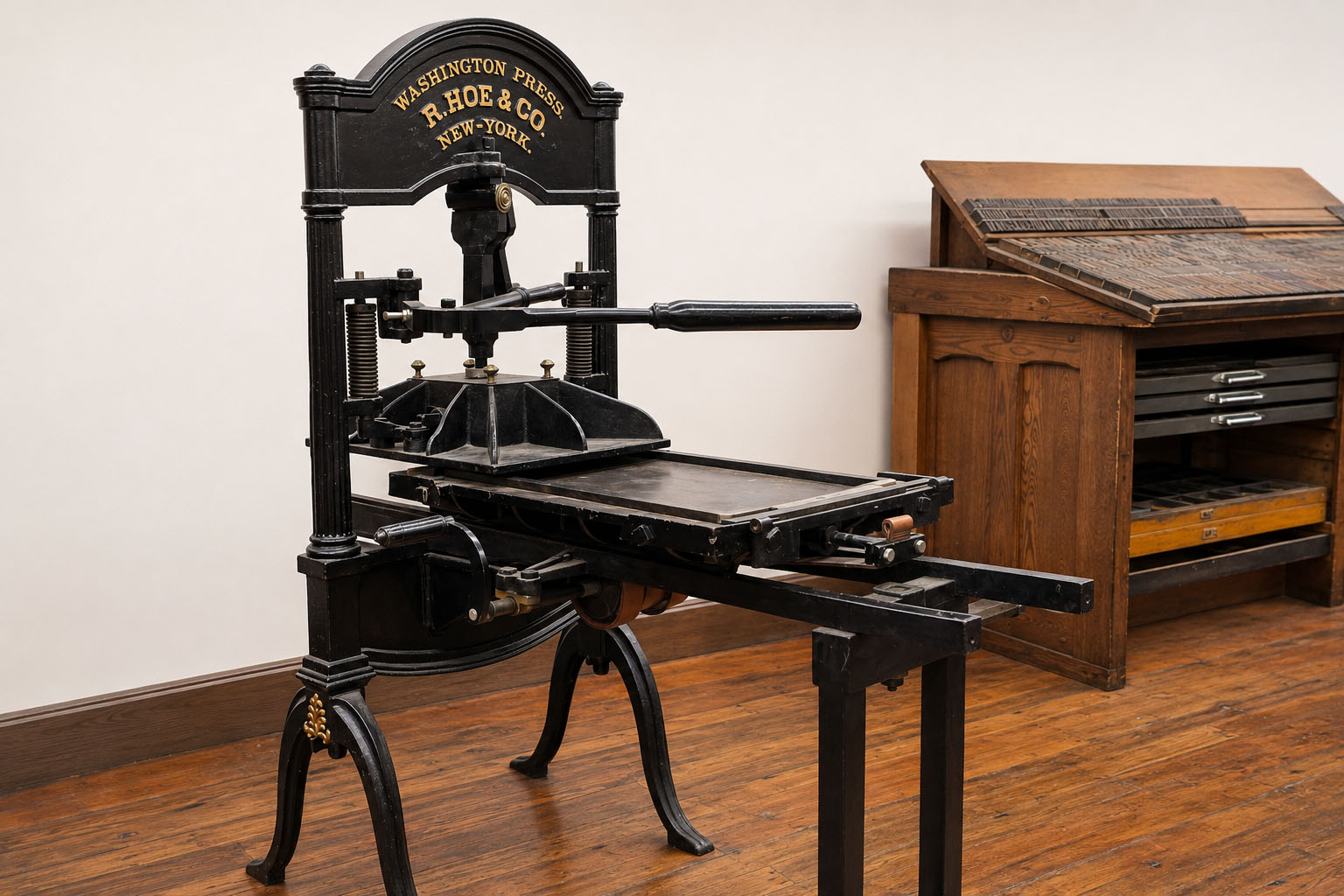
*The blog image of the printing press was taken by Felicia Chavez in 2025 while visiting Open Book in Minneapolis. The background was simplified, courtesy of AI.
Castleman, Michael. The Untold Story of Books: A Writer’s History of Book Publishing. Los Angeles: The Unnamed Press, 2024.