
Please note that you will be taken to a separate website maintained through The University of Chicago Press in order to securely complete your purchase. If you have issues placing your order or need additional assistance, please contact us.
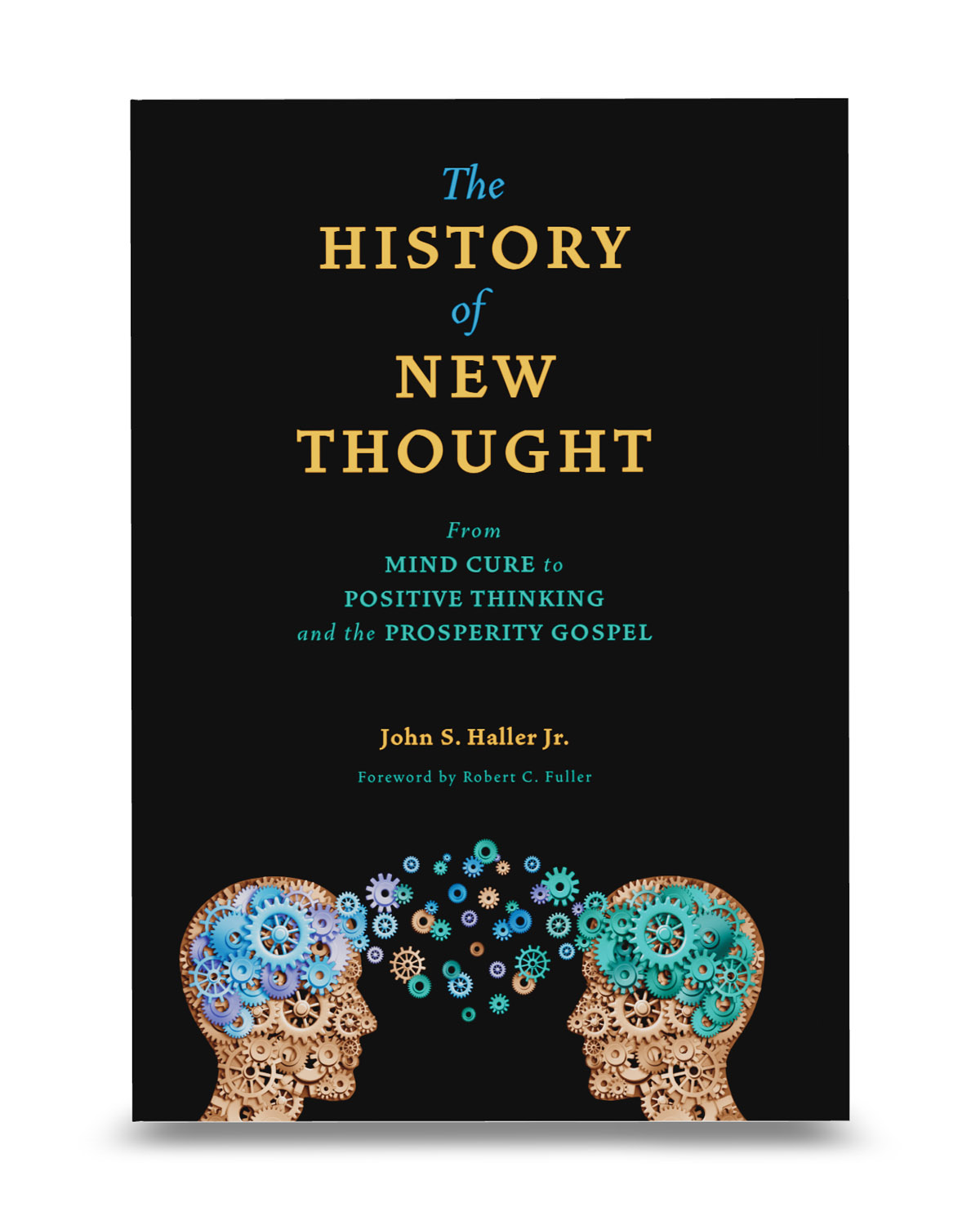
From Mind Cure to Positive Thinking and the Prosperity Gospel
By John S. Haller, Jr.
Foreword by Robert C. Fuller
Swedenborg Studies #21
Discover the fascinating story of the New Thought movement, a spiritual tradition that has shaped modern ideas about healing, self-improvement, and the power of the mind. The History of New Thought offers a clear and engaging overview of how this movement developed in America from the nineteenth century onward, tracing its roots in Transcendentalism, metaphysics, the writings of Emanuel Swedenborg, and the early mind-cure movement.
Through vivid portraits of influential figures such as Phineas Quimby, Mary Baker Eddy, Emma Curtis Hopkins, Charles and Myrtle Fillmore, and Ernest Holmes, this book reveals how New Thought gave rise to well-known institutions like Unity, Religious Science, and Christian Science. It also explores how concepts such as positive thinking and the law of attraction emerged from these teachings and continue to shape contemporary spirituality.
Offering historical insight and context, this book brings clarity to one of the most influential yet often misunderstood movements in American religious history.
Hardcover and e-book, 404 pages
Description
The New Thought movement has shaped the way many people think about spirituality, health, and the potential of the human mind. Emerging in the nineteenth century, it grew out of a unique blend of influences—including Transcendentalist philosophy, metaphysical teachings, and a growing interest in mental and spiritual healing. The History of New Thought: From Mind Cure to Positive Thinking and the Prosperity Gospel traces this development in detail, offering readers a thoughtful, well-researched account of how a diverse collection of individuals and ideas came together to form a lasting spiritual tradition.
At the heart of this story are the people whose ideas and practices defined the movement. Phineas Quimby’s early work with mental healing inspired many who followed, including Mary Baker Eddy, founder of Christian Science. Teachers like Emma Curtis Hopkins and leaders like Charles and Myrtle Fillmore brought New Thought to a wider audience through Unity and related organizations. Later, Ernest Holmes carried these ideas into the twentieth century with the founding of Religious Science, shaping how millions approach spirituality today.
Alongside these personal stories, the book explores the ideas themselves—concepts like the mind-body connection, the healing power of thought, and the belief that spiritual laws underlie the visible world. These teachings helped to inspire movements far beyond New Thought itself, influencing modern self-help literature, the rise of holistic health practices, and even the popular notion of the law of attraction.
This book situates New Thought within the broader sweep of American religious history, showing how it both reflected and shaped the culture around it.
Reviews
“This is a valuable and comprehensive survey of the religious movement called New Thought–a cluster of American theological and metaphysical systems based on the power of the human mind to transform personal realities and interact with the divine mind. Haller skillfully weaves the multifaceted strands of this diverse and divergent movement into a coherent narrative. Starting with the rejection of traditional Christian metaphysics, and drawing from inspiring figures such as Ralph Waldo Emerson, Anton Mesmer, and Emanuel Swedenborg, this movement quickly diversified in the 19th century, becoming an important part of American religious and social life. Innovators such as Phineas Quimby, Mary Baker Eddy, Charles and Myrtle Fillmore, and many others developed practical new metaphysics that met American needs. Haller traces this movement into the 20th century, through such diverse figures as Dale Carnegie, Norman Vincent Peale, and even Oprah Winfrey, along with Stephen Covey, Eckhart Tolle, Matthew Fox, and the Christian leaders of the Word of Faith movement. This fascinating and very readable book illuminates an important aspect of American culture and religion. Summing Up: Highly recommended.”
—M. A. Granquist, Luther Seminary, Choice
“Haller’s work on New Thought history is an engaging and welcomed addition to a recent trend of new books on the subject. The tapestry that is the history of New Thought is as varied and eclectic as the nation in which it was born. Haller pulls these threads together in a compelling fashion that gives the reader a deeper appreciation for the unique cultural context that gave rise to New Thought. Haller provides more than a historical review of where we emerged from; he also takes an honest look at how it happened. As such this book, more than any other in this genre, provides valuable insights into what the New Thought movement has become as it has both shaped and been shaped by the American psyche. I believe The History of New Thought will quickly become required reading for anyone who wants to know not only where New Thought came from, but also where it might go and grow from here.”
—Rev. David F. Alexander, senior minister, New Thought Center for Spiritual Living
“The popularity of the so-called Prosperity Gospel in modern American evangelicalism and the proliferation of exponents of this adaptation of Christian teachings have fascinated religious researchers for decades. But are there antecedents to this phenomenon that can help us understand its methods and motivations? Indeed, there is a long and complex history behind this movement, and in this fine work, author Haller (Swedenborg, Mesmer and the Mind/Body Connection: The Roots of Complementary Medicine) takes us into the heart of the uniquely American set of spiritual doctrines known as “New Thought” and shows how such thinkers as Emanuel Swedenborg, Mary Baker Eddy, and Norman Vincent Peale have affected the way we view religion and, indeed, God. Haller concludes that “New Thought marked a triumph of voluntarism, a vindication of religious freedom, and scorn for all forms of authoritarian creeds.” As such, it synthesizes the individualistic impulses of centuries of ecclesiastical radicals and serves it up in a distinctly American religious tradition. Haller, a historian at Southern Illinois University, Carbondale, artfully and persuasively pulls together a complex history and shines a much needed light on a seductive and popular religious movement.”
—Publishers Weekly (October 8, 2012)
“Haller (history and medical humanities, Southern Illinois U.) presents a history of “New Thought,” from colonial days to the present, which attends to its relationship with scientific discourse and worldly “success.” He explores the early foundations of New Thought in a rejection of pessimistic Calvinism in favor of self-directed theologies of emotion and intuition that tried to revive a spiritual core to Christianity that was hopeful of over-coming the “failings” of materiality. These traditions are grounded in Christianity and so East Asian religions in the west only figure as influences rather than developments. While he finds these traditions start out in earnest, they develop into various forms of spiritual hucksterism in the 20th century. To this end he considers the rise of Oprah, positive psychology’s assault on the failings of market society, and alternative forms of medicine. Since he focuses on ideas more than historical actors, two appendices list organizations and individuals affiliated with New Thought. This text is published by Swedenborg Foundation Press. Emmanuel Swedenborg is a prominent figure in this history.”
—Book News Inc., Portland, OR
About the Swedenborg Studies Series
Swedenborg Studies is a scholarly series published by the Swedenborg Foundation. The primary purpose of the series is to make materials available for understanding the life and thought of Emanuel Swedenborg (1688–1772) and the impact his thought has had on others. The Foundation undertakes to publish original studies and English translations and to republish primary sources that are otherwise difficult to access.
Additional information
| Author | John S. Haller, Jr. |
|---|---|
| Foreword | Robert C. Fuller |
| Format | e-book, hardcover |
| ISBN | 978-0-87785-348-0, 978-0-87785-630-6 |
| Length | 404 pages |
| Release Date | November 2012 |
| Series | Swedenborg Studies #21 |
Related books
-

Secrets of Heaven Vol. 2
-
Emanuel Swedenborg
-

Swedenborg and Esoteric Islam
-
Divine Providence
-

The Lives of Angels