
Please note that you will be taken to a separate website maintained through The University of Chicago Press in order to securely complete your purchase. If you have issues placing your order or need additional assistance, please contact us.
By Peter Rhodes
Edited by Jody Perkins and Ruth Zuber
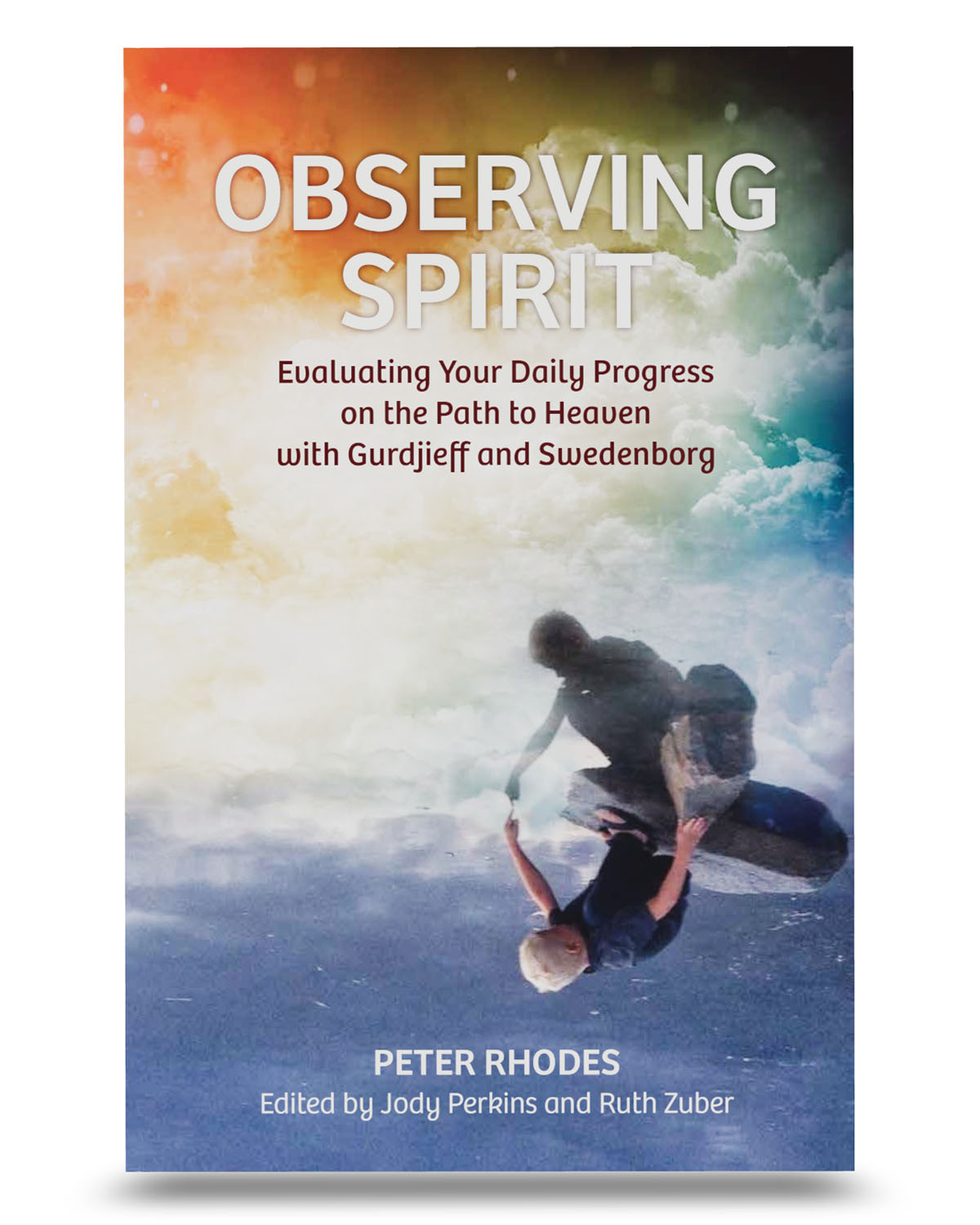
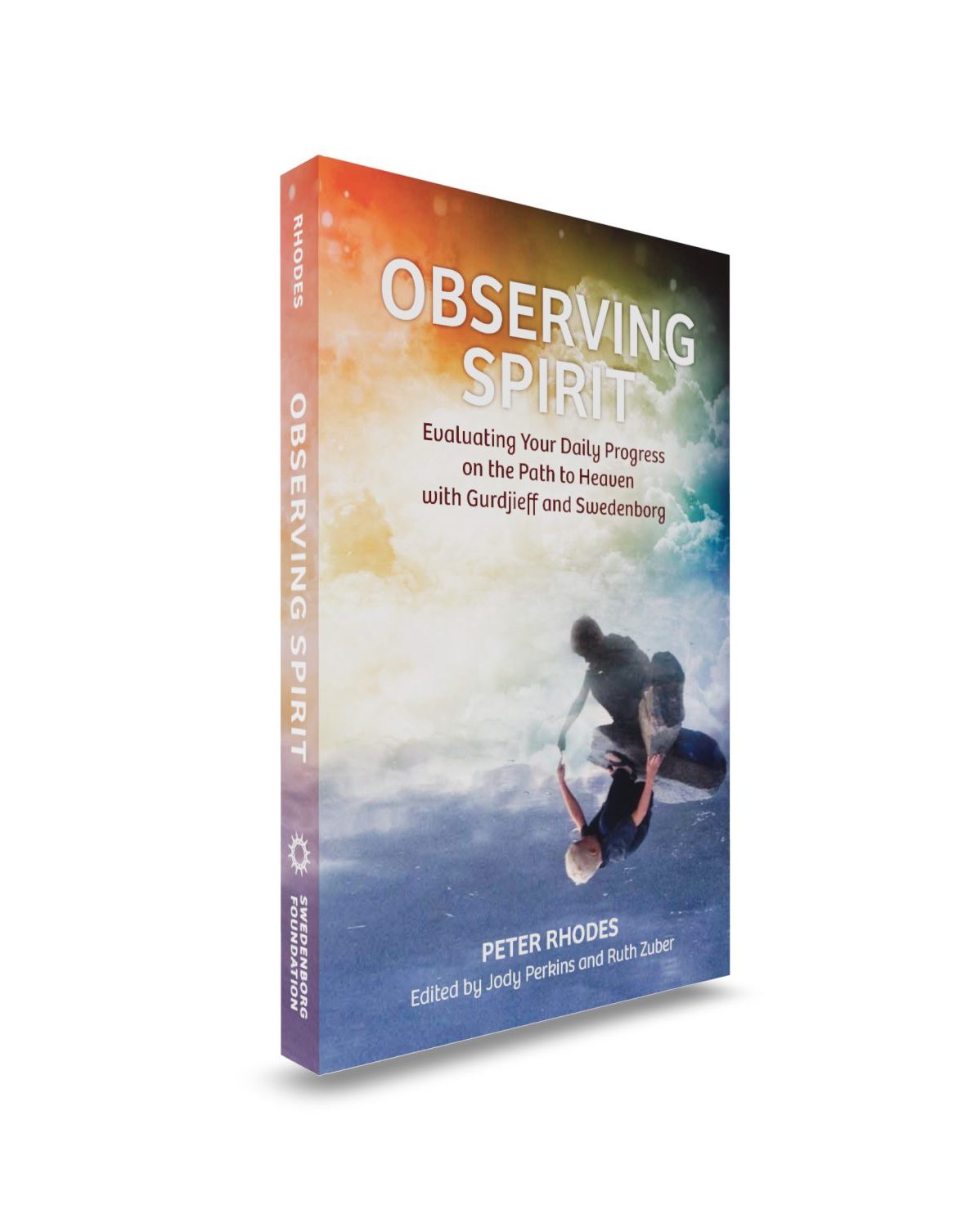
Observing Spirit offers a clear, practice-based approach to spiritual psychology drawn from the insights of Emanuel Swedenborg, Gurdjieff, P. D. Ouspensky, and Maurice Nicoll. Peter Rhodes brings these two worlds together—Swedenborg’s understanding of inner regeneration along with the Fourth Way’s methods of self-remembering, non-identification, and conscious attention—to help readers recognize their states of consciousness in everyday life.
Rather than presenting abstract ideas, the book guides you through practical steps for spiritual growth: how to observe your thoughts spiritually, how to distinguish higher impulses from mechanical reactions, and how to work with recurring negative emotions without judgment or suppression. Rhodes shows how inner work can illuminate the spiritual meaning of temptations, reshape habits of thought and feeling, and open space for more grounded, compassionate action.
Whether you are new to Swedenborgian thought, exploring the Fourth Way, or simply looking for daily spiritual exercises for self-improvement, Observing Spirit offers a method you can test in your own experience—moment by moment, state by state.
Paperback, 256 pages
Description
Observing Spirit invites readers into a disciplined yet humane approach to spiritual development—one that does not ask us to escape daily life, but to see it more clearly from within. Drawing deeply on the writings of Emanuel Swedenborg and the practical teachings of Gurdjieff, P. D. Ouspensky, and Maurice Nicoll, Peter Rhodes brings together two complementary traditions that both insist on one point: real spiritual change begins with honest self-observation.
We too can remember and forget in ways that are good. For example, we may want to forget (or let go of) a bad state or negative I. Perhaps someone affronts you in some way and you have a negative response; but you want to forgo that response and just forget it. What do you do? You try to access a higher state by Working. For example, if you can “stop thought” successfully, you may forget why you are angry. Although that same negative voice will try to remind you of the transgression, you will forget why you are angry if you can elevate your thinking and fill your mind with some appreciation of that person for something he or she has done in the past. Use any of the tools outlined in this book for changing your state, and you will allow the Lord to help you go into forgetfulness or forgiveness of whatever the other person did.
A Bridge Between Swedenborg and the Fourth Way
Swedenborg describes the mind as layered and teaches that regeneration unfolds as we learn to recognize the origins of our thoughts and feelings. The Fourth Way offers tools for exactly this kind of inner noticing: self-remembering, non-identification techniques, and the effort to divide attention so that we are not carried away by habitual reactions. Rhodes shows how these systems illuminate each other. Swedenborg gives a spiritual framework for why inner work matters; Gurdjieff provides techniques for how to do it.
Learning to Observe Your Inner States
Much of the book focuses on learning how to observe your thoughts spiritually. Instead of pushing away disruptive emotions, Rhodes encourages non-judgmental self-observation, allowing readers to see negative states—irritation, jealousy, anxiety, self-pity—as temporary conditions rather than fixed identities. This shift makes it possible to understand the spiritual meaning within any state of being and to reduce the power of recurring emotional patterns.
Rhodes also explores the challenge of recognizing different states of consciousness, showing how our reactions shift depending on which “I” is active at the moment. This approach enables readers to work more skillfully with themselves, using Fourth Way practices to interrupt mechanical responses and Swedenborg’s insights to understand the deeper spiritual dynamics at play.
Practical Work for Real Life
Each chapter includes a concrete task designed to help readers apply these ideas immediately. These include:
- daily spiritual exercises for self-improvement,
- prompts for observing your inner states as they arise,
- guidance for experimenting with self-remembering,
- ways to identify and separate from recurring negative emotions, and
- instructions for trying different responses to familiar situations.
Rhodes emphasizes that spiritual work is not about striving to become idealized versions of ourselves. Instead, it is about becoming more awake spiritually—learning to pause, see what is happening, and choose our direction with greater awareness.
A Path for Seekers of Many Backgrounds
Observing Spirit speaks equally to those grounded in practical Christian mysticism, readers familiar with Swedenborg’s theology, and seekers drawn to the Fourth Way. It offers guidance without dogma, structure without rigidity, and a method that can be verified through one’s own experience. For anyone exploring inner work for emotional transformation or looking to apply the Fourth Way to everyday life, this book provides a thoughtful companion on the path.
By integrating two rich traditions into a single, accessible process, Observing Spirit offers not just ideas, but a way of practicing that can radically shift the course of daily life—one moment of awareness at a time.
Reviews
Rhodes has done us all a real service by putting together this workbook on spiritual progress as something that must grow out of daily practice and concrete intention.
—Frederic and Mary Ann Brussat, Reviewers, Spirituality & Health, September, 2005
Additional information
| Author | Peter Rhodes |
|---|---|
| Editor | Jody Perkins, Ruth Zuber |
| Format | e-book, paperback |
| ISBN | 978-0-87785-668-9, 978-0-87785-316-9 |
| Length | 252 pages |
| Release Date | 2005 |
Related books
-
Secrets of Heaven Vol. 2
-

Scribe of Heaven
-
Schelling and Swedenborg
-
Swedenborg, Mesmer, & the Mind/Body Connection
-

Divine Love and Wisdom