As we head toward the publication of Secrets of Heaven, Volume 12: The Portable New Century Edition, we thought we’d share a look at some of Emanuel Swedenborg’s original Neo-Latin handwriting: What does Swedenborg’s handwriting actually look like—and how do we read it today, nearly 270 years later?
The Israelites are in the desert after having escaped from Egypt. Our example passage is Swedenborg’s close look at Exodus 16:21. In this passage, manna from heaven saves them from starving, and there are rules around how manna functions and how it is to be gathered.
The first line in Neo-Latin:
“‘Et incaluit sol et liquefactum est’: quod significet quod evanescat secundum gradum crescentis concupiscentiae…”
New Century Edition Translation (translated by Lisa Hyatt-Cooper):
“‘And the sun grew hot, and it melted’ means its disappearance gradually as craving increased.”
Swedenborg interprets the original biblical text as having spiritual significance; that is, insight about the interplay of god’s love, truth, and faith on the one hand, and on the other, self-love, materialism, and cravings.
Below we will examine Swedenborg’s original handwriting in detail.
First, as you can see in the image below, the number “8487” is clearly visible in the upper left. This tells us that the numbering system that Swedenborg used upon original publication of Arcana Coelestia (“Secrets of Heaven”) remains intact in current editions of his work.

The first word written here, “Et,” means “And.”
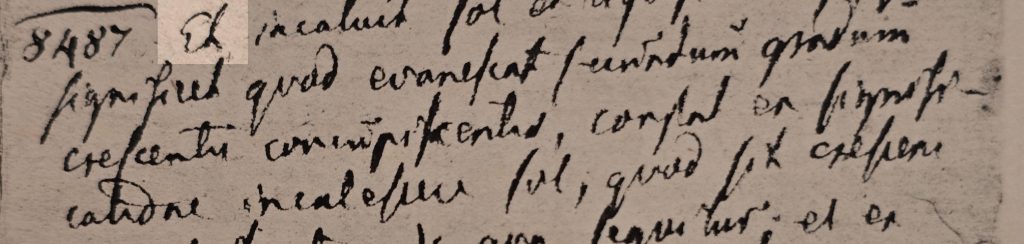
You’ll notice that, though this is the beginning of the Exodus quote, Swedenborg does not enclose the quotation in quotation marks. Later editions and translations of his works used quotation marks or italicized text of bible quotes in order to improve clarity for the reader. (Generally, using quotation marks to denote direct quotes becomes common later, in the nineteenth century.)
The next Latin word is “incaluit.” If you’re familiar with Spanish, you may recognize “caluit” as echoing “caliente” meaning “hot.” (Incidentally, this is also related to our English word “calorie.”) However, the “in” of “incaluit” intensifies the verb, and the verb itself carries the sense of becoming or growing hot. So it’s not just “hot,” but something heating up or increasing in heat.

In Swedenborg’s interpretation, this increasing heat signifies growing cravings that cause goodness–the manna–to disappear.
If you’ve ever peered at Swedenborg’s original handwriting in the past and tried to read it, you may have been tripped up by the “ſ” letter. You can see an example of this in the next word, which Swedenborg wrote as “ſol,” meaning “sol,” meaning “sun.”

This “ſ” character was simply a then-current convention that tended to be used at the beginning and in the middle of words (not so much at the end), but was just a different way of writing “s.” It was a “long s,” meaning elongated, with no effect on pronunciation.
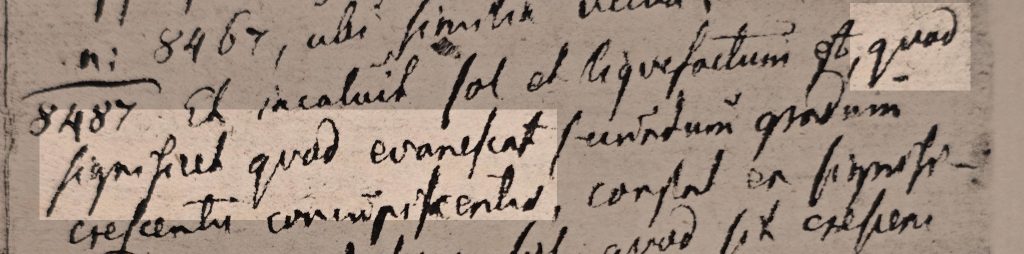
Now we have “et” again, followed by “liquefactum est,” meaning, “it melted.” You probably recognize the word “liquefactum” as very similar to the modern English word “liquified.” (And “est” is written with the “ſ” letter here as well, “eſt” as opposed to “est.”)

Having completed the biblical quote Swedenborg is elucidating, he now tells us what he understands this passage in Exodus to mean. He begins, “…quod significet quod evanescat…”(You can tell from the slightly diagonal tilt of the script that even Swedenborg wasn’t great at writing in straight lines!)
A somewhat literal translation of this part of the text is something like this:
“…which signifies that it vanishes…”
It’s potentially confusing because translating this neo-Latin passage into modern English requires that we translate the Latin word “quod” in two different ways, “which” and “that it.” But you probably recognize the Latin word “significet” as resembling “signifies,” and “evanescat” echoing our modern word “evanescent.”
Swedenborg continues in Latin:
“…secundum gradum crescentis concupiscentiae…”
New Century Edition Translation:
“…as craving increased.”
“Secundum gradum” in the context of this sentence means “according to,” “in accordance with,” or simply, “as.”
“Crescentis concupiscentiae” is, you may have deduced by now, “increased cravings.” But there are a variety of English words that could be used for each of these two Latin words. “Crescentis” is translated by the NCE team as “increase,” but could also be translated as “growing.” The colorful word “concupiscentiae” could be read as cravings, desires, lust, or simply left as “concupiscence.”
Likewise, the NCE team chose to end the sentence here. As a whole effort, they prioritize modern English and readability. However, Swedenborg’s original sentences could be quite lengthy, and some translations continue the sentence.
Finally, for further context, below is the text of the NCE translation. Note that Swedenborg did, in fact, include that lengthy list of cross-references to other sections of Secrets of Heaven in his original text.
8487. ‘And the sun grew hot, and it melted’ means its disappearance gradually as craving increased. This is clear from the meaning of ‘the sun growing hot’ as craving that is increasing, dealt with below; and from the meaning of ‘melting’ as disappearing. The reason why ‘the sun grew hot’ means craving that was increasing is that ‘the sun’ in a good sense means heavenly love. It means this because the Lord is the Sun in the next life, the heat which comes from it being the good of love, and the light the truth of faith. (For more about that Sun — that it is the Lord and that heavenly love comes from it — see 1053, 1521, 1529-1531, 2120, 2441, 2495, 3636, 3643, 4060, 4321 (end), 4696, 5084, 5047, 5377, 7078, 7083, 7171, 7173, 7270.) Therefore ‘the sun’ in the contrary sense means self-love and love of the world, and the heat from the sun or its ‘growing hot’ in that sense means craving.
This single example of one brief line shows us the progression from Swedenborg’s original handwritten manuscript through to a 2026 publication of Secrets of Heaven, Volume 12. When completed, the New Century Edition of Swedenborg’s Secrets of Heaven series will be fifteen volumes. We hope to bring you more detailed examinations of Swedenborg’s original handwriting in the future.
If you are not already on our mailing list, sign up here.
Thank you to Jonathan Rose and Chara Daum for their fact-checking support.